
How to Tell Hyundai Trim Level by VIN (Complete 2026 Guide)
Search Window Sticker
Table of Contents
Key Takeaways
 A Hyundai VIN can identify key vehicle details such as the model year, engine, transmission, and assembly plant, but it does not always directly reveal the trim level.
- A factory window sticker provides the most complete factory specifications, including the original trim, MSRP, packages, standard equipment, and optional features.
- Verifying the trim level is important when buying, selling, insuring, or ordering replacement parts for a Hyundai, as equipment can vary between trims and optional packages.
- Get the Hyundai window sticker to check the trims and other information such as features, options, MSRP, warranty, and safety ratings.
Two Hyundai vehicles may look almost identical but have completely different trim levels. One could include leather seats, a panoramic sunroof, and advanced driver assistance features, while the other comes with only the essentials. Since badges can be replaced or removed, checking the VIN is one of the most reliable ways to identify the original trim.
This guide explains what a Hyundai VIN can reveal, when factory records are required, and why a window sticker remains the best way to verify a vehicle's original configuration.
What is a Hyundai Trim Level?
A model is the vehicle family, such as the Hyundai Elantra. A trim is a factory version, such as SE, SEL, or Limited. A package adds selected equipment without always changing the trim name. Two Elantra SEL vehicles may differ because only one received an optional package. Trim names also vary by year and market.
Common Hyundai Trim Levels
Hyundai reuses several trim names across cars and SUVs, but their equipment is not identical on every model. Current Hyundai listings show different applications of SE, SEL, Limited, Blue, XRT, N Line, and Calligraphy naming.
Entry-Level Trims
SE commonly identifies a core, lower-priced trim. Blue often identifies an efficiency-focused hybrid version.
Mid-Level Trims
SEL usually adds comfort or technology. Names such as SEL Convenience or SEL Premium may include grouped features. XRT often adds rugged exterior styling on Hyundai SUVs.
Premium Trims
Limited and Calligraphy generally sit near the top of a model range. N Line is sport-oriented, while a full N model is a separate high-performance version.
Why Trim Levels Matter
Trim can change the powertrain, wheels, materials, technology, safety features, MSRP, parts fitment, and vehicle value. Packages may still make a lower trim resemble a higher one.
Why Knowing Your Hyundai Trim Level Is Important
Before you decide to purchase a used Hyundai, checking the actual trim level is important because one trim can cost more than the others. Here are more reasons why you need to check the actual Hyundai trim:
Buying a Used Hyundai
Trim verification helps buyers compare similar vehicles and avoid overpaying. Leather seats alone do not prove a Tucson is a Limited. Check a Vehicle History Report separately for title, accident, mileage, and ownership records.
Selling a Hyundai
An accurate trim improves the listing and reduces disputes. List packages separately instead of calling every well-equipped SEL a Limited.
Ordering the Correct Parts
Trims may use different engines, brakes, wheels, headlights, sensors, or modules. Provide the complete VIN, then confirm the part number against the installed component.
Determining Vehicle Value
Trim affects MSRP, insurance, trade-in value, and resale value. An MSRP by VIN lookup may recover original pricing, not current market value.
Can a VIN Tell Your Hyundai Trim Level?
Yes, a Hyundai VIN can identify your trim level, though it requires decoding specific character positions or using an online Hyundai VIN lookup service.
What Information Does a Hyundai VIN Contain?
A modern U.S.-market VIN has 17 characters. It identifies the manufacturer, selected vehicle attributes, model year, plant, and production sequence. Hyundai may also encode the body, restraint system, engine, or drivetrain.
Is the Trim Name Encoded in the VIN?
Hyundai VINs generally do not reserve one universal character for names such as SE, SEL, XRT, or Limited. Positions four through eight describe manufacturer-defined vehicle attributes, not a standardized retail trim label. Hyundai’s published decoding guide, for example, assigns characters to the vehicle line, series, body, restraint system, and engine.
How to Tell Hyundai Trim Level by VIN
To tell Hyundai trim level by VIN, you must be able to locate the VIN first. Then, you may use the Hyundai VIN decoder or get the window sticker.
Step 1: Locate the VIN
Check the lower driver-side windshield, driver’s door jamb, registration, title, or insurance documents. NHTSA also identifies the windshield and driver-side door jamb as common VIN locations. Use all 17 characters.
Step 2: Decode the VIN
Enter the VIN into a Hyundai VIN Decoder. Confirm the year, model, engine, body, and drivetrain to narrow the possible trims.
Step 3: Verify Using the Factory Window Sticker
A valid window sticker links the VIN to its retail trim, pricing, and factory equipment. Always compare the displayed VIN with the vehicle.
Information Found on a Hyundai Window Sticker
A Hyundai window sticker commonly includes:
- Trim, engine, and transmission
- Exterior and interior colors
- Standard equipment
- Optional equipment and packages
- Base MSRP, option prices, and total MSRP
- Fuel economy and applicable safety ratings
Federal consumer guidance describes the Monroney sticker as showing the base price, manufacturer-installed options, transportation charge, and fuel economy. NHTSA also requires available 5-Star Safety Ratings information on new-vehicle labels.
Understanding Hyundai VIN Characters
Federal rules divide the 17 characters into standard sections. Hyundai assigns detailed meanings within the descriptor positions.
Characters 1–3: World Manufacturer Identifier
The first three characters identify the manufacturer, make, and vehicle type. Hyundai uses different identifiers for some production countries and vehicle types. SAE International coordinates WMI assignment procedures in the United States.
Characters 4–8: Vehicle Descriptor Section
Positions four through eight describe attributes such as line, body, restraint system, engine, or weight class. Meanings vary by model year.
Character 9: Check Digit
Position nine checks transcription accuracy. It does not describe the trim, engine, or package.
Character 10: Model Year
Position ten identifies the model year: L means 2020, M 2021, N 2022, P 2023, R 2024, S 2025, and T 2026. Codes repeat, so consider the full VIN.
Character 11: Assembly Plant
Position eleven represents the assembly plant. A decoder can translate it when current plant data is available.
Characters 12–17: Production Sequence Number
The final six positions distinguish the vehicle within production. They do not reveal its complete option list.
What VIN Decoding Can Confirm
If you need to check the car’s actual specs, you can refer to the Hyundai VIN decoder. These are the types of information you’ll be getting from decoding a Hyundai VIN.
Engine Type
The VIN can often identify the engine family, helping separate gasoline, turbocharged, and hybrid configurations.
Transmission
Decoder results may identify the transmission, but factory records provide stronger confirmation.
Hybrid vs Gasoline
VIN data can normally distinguish an Elantra Hybrid from a gasoline Elantra. That distinction greatly narrows the possible trim list. Elantra lineups have used SE, SEL, Limited, N Line, Blue, and Hybrid Limited names. Hyundai lists separate gasoline and hybrid choices for 2026, so verify the exact year.
Hyundai Tucson Trim Levels by VIN
Tucson lineups include SE, SEL, XRT, Limited, and electrified versions. The 2026 U.S. range also uses SEL Plus, SEL Premium, Blue SE, and SEL Convenience. Plug-in hybrids follow their own structure.
Features That Differentiate Tucson Trims
The pattern below is general. Exact equipment varies by year and market.
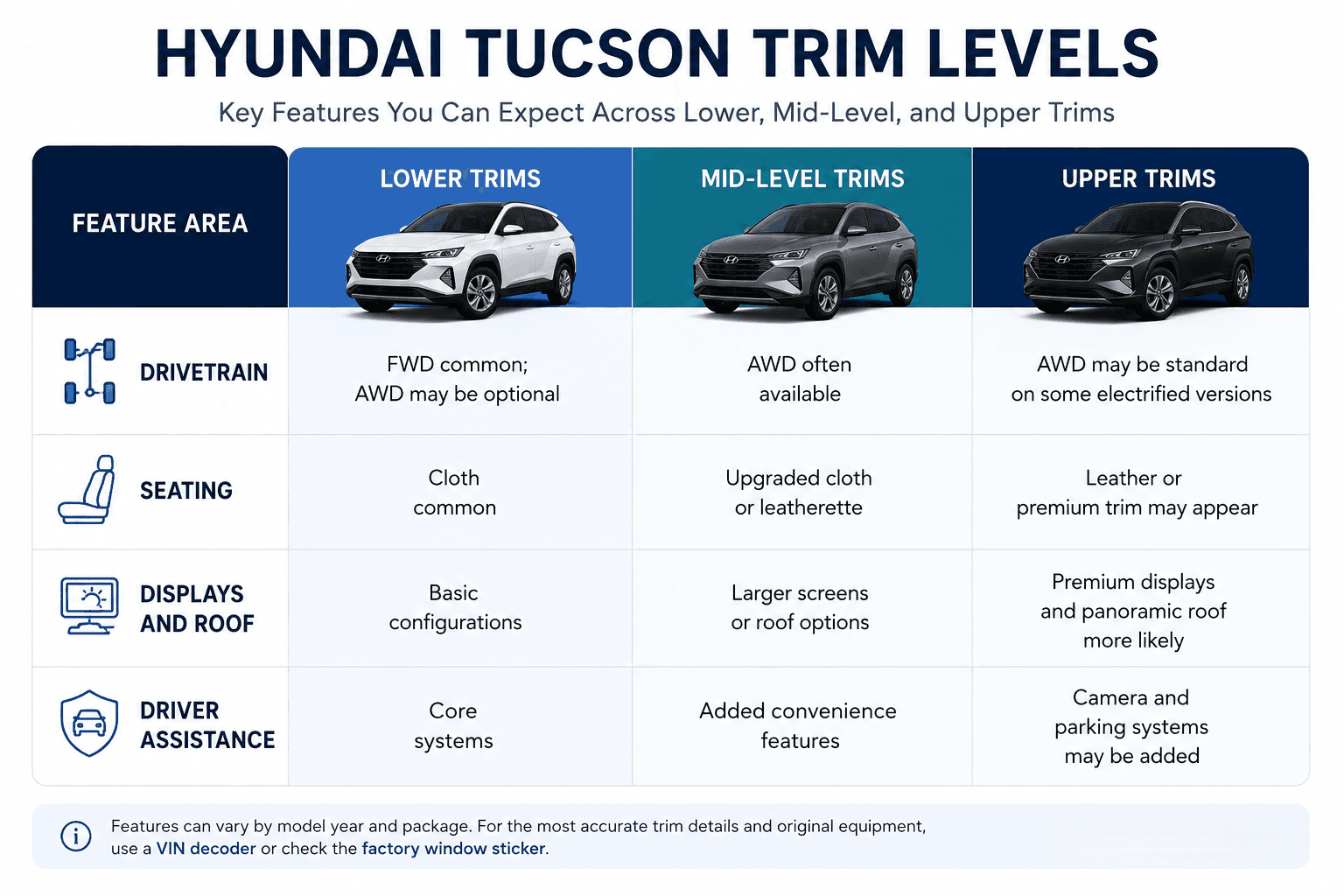
Hyundai’s current Tucson pages show that seating, displays, drivetrain availability, and driver-assistance equipment differ between trims and powertrains.
Other Hyundai Models That Can Be Identified by VIN
Our service can be used to check the complete Hyundai trim information by using the VIN.
Hyundai Sonata
A Sonata VIN identifies core vehicle and powertrain details. Factory records separate SE, SEL variants, N Line, and hybrid trims.
Hyundai Santa Fe
Santa Fe lineups may include SE, SEL, XRT, Limited, Calligraphy, and hybrid alternatives. Markets may differ.
Hyundai Palisade
Palisade trims may differ in seating, powertrain, and technology. Premium versions often use Calligraphy naming.
Hyundai Kona
A Kona VIN distinguishes year, engine, drivetrain, and electric versus gasoline versions. Build records verify the trim. Hyundai lists four gasoline Kona trims for the 2026 U.S. market.
Hyundai Venue
For Venue, decode basic attributes first, then check year-specific factory information.
Hyundai Ioniq Models
Ioniq covers Ioniq 5, Ioniq 6, and earlier hybrids. Confirm the full model, powertrain, drivetrain, and trim.
VIN Decoder vs Window Sticker
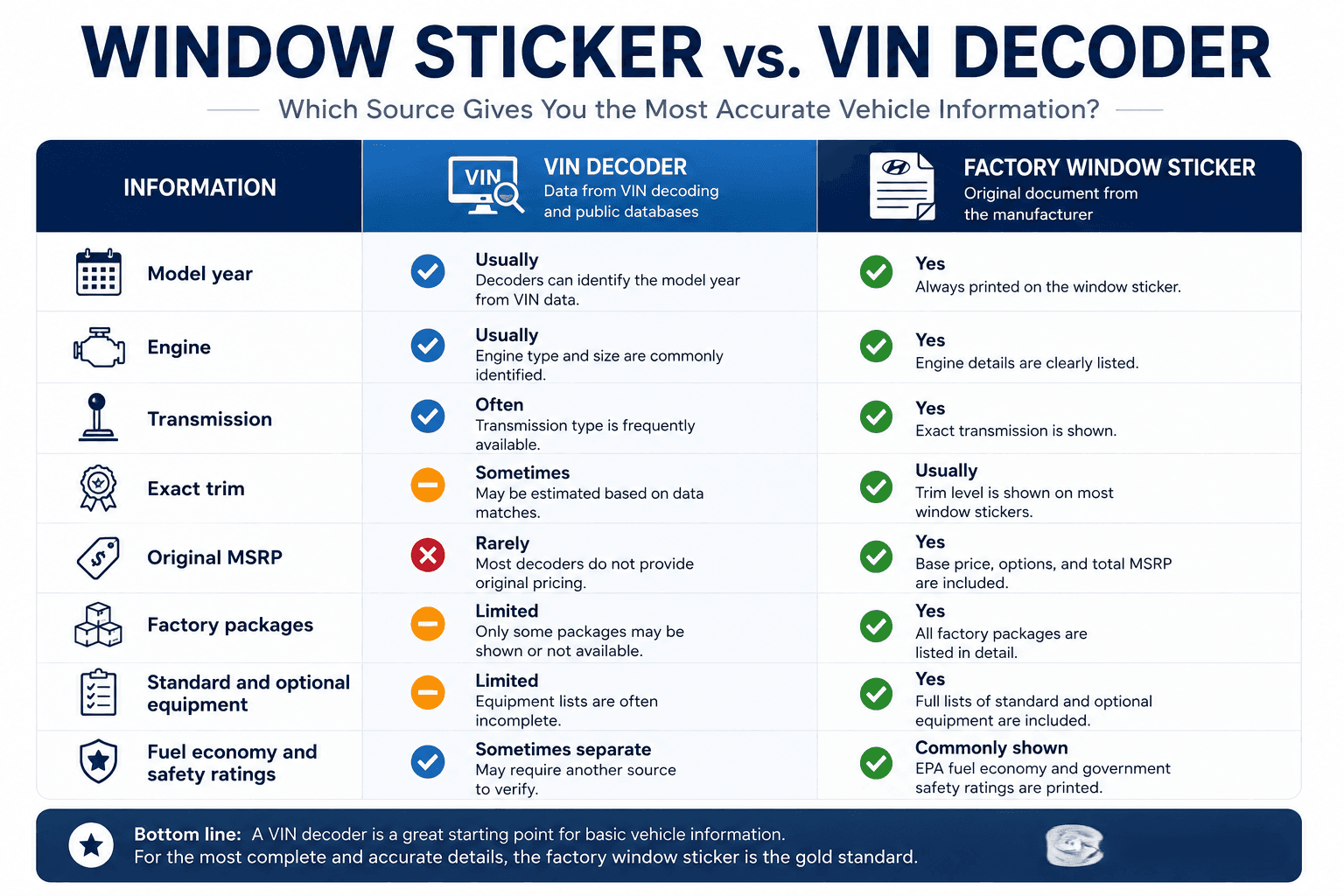
A VIN decoder quickly checks the year, engine, body, and drivetrain. It also supports a Hyundai Warranty Check or recall search, although recall status comes from a separate NHTSA database.
Advantages of a Factory Window Sticker
A factory window sticker shows original retail, package, option, and pricing details. It does not prove current condition, ownership, or accident history.
Which One Should You Use?
Common Mistakes When Identifying Hyundai Trim Levels
Even with a VIN lookup, identifying a Hyundai's original trim isn't always straight to the point. Trim names, factory packages, and model-year updates can create confusion, especially when buying a used vehicle. Avoid these common mistakes before concluding.
Trusting Exterior Badges
Badges can be misleading. Previous owners sometimes replace damaged emblems, add badges from higher trims, or remove them during repairs and repainting.
Ignoring Optional Packages
A package can add features associated with a higher trim without changing the trim name. Check packages separately.
Using Generic VIN Decoders
Some services only translate VIN characters. Others add registration or manufacturer-linked data. A blank trim result may simply mean the service lacks build records.
Assuming Every Model Year Uses the Same Trim Names
Hyundai changes trim names and standard equipment over time. Match every comparison to the exact model year and sales market. Hyundai’s 2026 Elantra, Tucson, and Sonata lineups illustrate how names and equipment differ across models.
Conclusion on Finding Hyundai Trims by VIN
Identifying a Hyundai trim level by VIN is one of the most reliable ways to verify a vehicle's original configuration, especially when badges, optional packages, or previous modifications create confusion. While a VIN decoder can confirm specifications such as the model year, engine, transmission, and drivetrain, it may not always identify the exact trim from the VIN alone.
Verify the vehicle with its Hyundai window sticker. It provides the original trim level, MSRP, factory-installed packages, standard and optional equipment, exterior and interior colors, fuel economy, and other specifications exactly as the vehicle left the assembly line.