
How to Find Your Hyundai's Window Sticker by VIN?
Search Window Sticker
Table of Contents
Key Takeaways
 A Hyundai window sticker (Monroney label) is a factory-issued document that lists original pricing, trim level, standard features, optional packages, and EPA fuel economy ratings.
- Your 17-character VIN is the key to retrieving it; locate yours on the dashboard, door jamb, or your vehicle title.
- The easiest and fastest way to find a Hyundai window sticker by VIN is through a third-party VIN lookup tool, which doesn't require a dealer account or original ownership.
Most people don't think about a window sticker until it's gone. The dealer keeps it after the sale, the car changes hands, and the only factory record of how that Hyundai was originally built and priced disappears with it. Whether you're buying a used Hyundai, selling one privately, or just trying to confirm what your car came with from the factory, that document matters.
A window sticker can often be retrieved using nothing more than your VIN. This guide covers all of them all and gives you a few methods you can use to get the window sticker.
What is a Hyundai Window Sticker (Monroney Label)?
The window sticker, formally called a Monroney label, is a federally mandated document that every new car must display before it's sold. The name comes from Senator Mike Monroney, who sponsored the Automobile Information Disclosure Act of 1958, which made these labels a legal requirement. The law exists to protect buyers from misleading pricing and to ensure transparency about how a vehicle is equipped.
Hyundai's version of the label includes the manufacturer's suggested retail price, all factory-installed options and their costs, EPA fuel economy estimates, safety ratings, and basic warranty information.
What You Need Before You Start
Before you can get a Hyundai window sticker by VIN, you need two things: the correct VIN and a lookup method that covers your vehicle's model year. Getting either one wrong will send you down a dead end.
Locating Your VIN
Your Hyundai's VIN appears in several places. The most common is the dashboard plate; a small metal strip visible through the lower-left corner of the windshield on the driver's side. You can read it without opening the door. You'll also find it on the driver's door jamb sticker, which usually includes the VIN alongside tire pressure specs and paint codes.
Confirming Your VIN Is Valid
A valid Hyundai VIN is always exactly 17 characters. It will never contain the letters I, O, or Q; these were excluded from the VIN standard to avoid confusion with the numbers 1, 0, and 0. If your VIN has fewer than 17 characters, includes one of those letters, or was copied from a blurry photo, double-check before you run any lookup.
Why Do You Need a Hyundai Window Sticker?
A Hyundai window sticker does more than display the original MSRP. It's a factory-issued record of exactly how that vehicle was configured before it ever left the assembly plant. For anyone buying, selling, or researching a used Hyundai, it fills a gap that no other document reliably covers.
Verify Original Factory Equipment
Trim levels across Hyundai's lineup can differ significantly from one package to the next. The window sticker confirms the original engine, transmission, trim level, wheel size, and every factory option. If a seller claims the car has a turbocharged engine or an advanced driver assistance package, the sticker either backs that up or contradicts it.
Check the Original MSRP and Compare Used Vehicles
The sticker lists base price, each option's cost, the destination charge, and the total suggested retail price. Two Hyundai Tucsons from the same model year can look nearly identical in a listing and carry very different equipment levels. Without the original sticker, you're comparing seller descriptions. With it, you're comparing facts.
Identify Missing or Modified Features
Wheels get swapped. Badges come off. Accessories are added or removed over time. The window sticker shows the factory configuration, so you can tell whether a vehicle still matches what Hyundai delivered or whether it's been modified since leaving the assembly plant.
Methods to Get a Hyundai Window Sticker by VIN
There's no single universal method that works for every Hyundai, every year, and every ownership situation. Here's a clear-eyed look at what's actually available.
Hyundai Owner's Portal (MyHyundai)
Hyundai's MyHyundai website lets registered owners access vehicle documents, potentially including the original window sticker. If you purchased a new Hyundai and registered it through the portal, this is a reasonable first stop.
The catch: it only works for the original registered owner. Bought the car used, or the previous owner never registered? You won't get in. Coverage for older model years is also spotty. This route works well for a narrow group of people and not at all for most used-car situations.
Ask the Selling Dealer
A franchised Hyundai dealer can sometimes pull historical build data from Hyundai's systems, especially if they were the original selling dealer. It's worth asking, but the response varies widely depending on the dealership, the service advisor, and whether the records still exist. Independent lots and private sellers have no access to these systems, so this option doesn't apply in those transactions.
Third-Party VIN and Window Sticker Lookup Tools
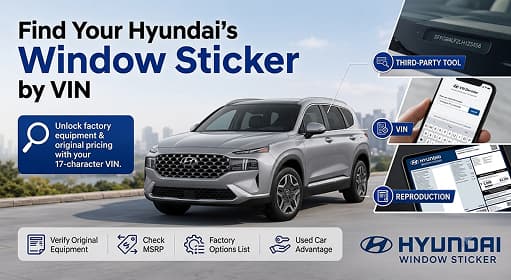
Third-party lookup services pull from manufacturer build databases to generate window sticker reproductions based on the vehicle's factory configuration at the time it was built. These tools don't require a dealer account, original ownership, or even a phone call. You enter a VIN, and the tool returns the sticker data.
NHTSA VIN Decoder
The National Highway Traffic Safety Administration maintains a free VIN decoder at nhtsa.gov. It returns basic build specifications, model year, make, model, engine, body style, pulled from manufacturer records submitted during the vehicle certification process.
This is genuinely useful for confirming core specs, but it's not the same as a Hyundai window sticker. The NHTSA decoder won't give you original pricing, option packages, interior and exterior color codes, or the formatted Monroney label.
What Information Can You Find on a Hyundai Window Sticker?
A window sticker is more detailed than most people realize. It's a structured document covering pricing, mechanical specs, standard equipment, factory options, safety details, and vehicle identification all tied to that specific build.
Pricing: MSRP, Options, and Destination Charge
The sticker lists the base MSRP for the specific trim, the cost of each factory option or package, the destination and delivery charge, and the total suggested retail price. This breakdown shows exactly how the vehicle was priced when new, useful context for anyone negotiating on a used Hyundai.
Equipment: Standard Features, Options, and Packages
Standard equipment for the trim is listed separately from factory-installed options. You'll see infotainment specs, seating materials, driver assistance systems, convenience features, and any optional packages, technology upgrades, premium audio, and appearance packages along with their individual costs. This is the clearest way to verify what actually came on the car versus what a seller added later.
Mechanical and Drivetrain Specs
Engine displacement, transmission type, and drivetrain configuration front-wheel drive, AWD, or four-wheel drive all appear on the sticker. For Hyundais with hybrid or electric powertrains, battery and motor details are included as well. Comparing this against the physical vehicle can reveal powertrain swaps or misrepresented configurations.
Fuel Economy, Safety, and Identification
EPA city, highway, and combined fuel economy figures appear alongside annual fuel cost estimates and greenhouse gas ratings. Safety equipment and crash test information may be included depending on the model year.
The VIN, production plant, model year, and vehicle classification round out the sticker, the identification data used in title transfers, insurance claims, and registration.
What to Do If No Window Sticker is Available?
Sometimes a sticker simply doesn't exist in any retrievable database. This happens most often with older vehicles.
Older Vehicles
Hyundai's digital records generally don't extend back to early production years in a way that supports window sticker retrieval. For vehicles from the late 1990s and early 2000s, there may be no database record to pull from. In these cases, original paperwork from the first owner, if it still exists, is the only real source for the window sticker.
Using a Vehicle History Report as a Substitute
Title history, accident records, reported mileage, and ownership count are all things a history report covers that a window sticker doesn't. Think of them as complements, not substitutes. If you can't get the original window sticker for a used Hyundai, pulling a vehicle history report is still worth doing; it answers different questions, and both sets of answers matter.
Common Mistakes When Looking Up a Window Sticker by VIN
A few errors show up repeatedly when people try to retrieve a Hyundai window sticker by VIN number. Knowing them in advance saves time.
Transposed Characters in the VIN
A single wrong digit or letter returns nothing, or returns data for the wrong car. Always copy the VIN directly from the source rather than transcribing it by hand.
Assuming All Sites Cover All Model Years
Coverage varies by tool and by brand. A service that works well for late-model Hyundais may have nothing for a 2007 Sonata. Check before you pay.
Confusing a Build Sheet With a Monroney Sticker
A build sheet is an internal manufacturing document that lists assembly-line specs. It's not the same as the Monroney label, doesn't include pricing, and isn't consumer-facing. Some dealers will provide a build sheet when a window sticker isn't available; it's useful, but it's a different document.
Paying For a Sticker On a Site With No Data Transparency
If a site won't tell you where its data comes from or which model years it covers, that's a warning sign. Reputable tools are straightforward about their sources.
Conclusion on Getting a Hyundai Window Sticker by VIN
A Hyundai window sticker is a factory-issued record of how a vehicle was originally built and priced, trim level, standard equipment, option packages, mechanical specs, EPA ratings, and original MSRP. No other document covers all of that in one place.
The right retrieval method depends on your situation. Original owners with a MyHyundai account can try the owner portal first. For used car buyers and anyone without original ownership, a third-party VIN lookup tool like Hyundai Window Sticker is the most reliable route, with no dealer visit required. For older vehicles where no digital record exists, a vehicle history report fills in a different set of gaps.