
Search Window Sticker
Table of Contents
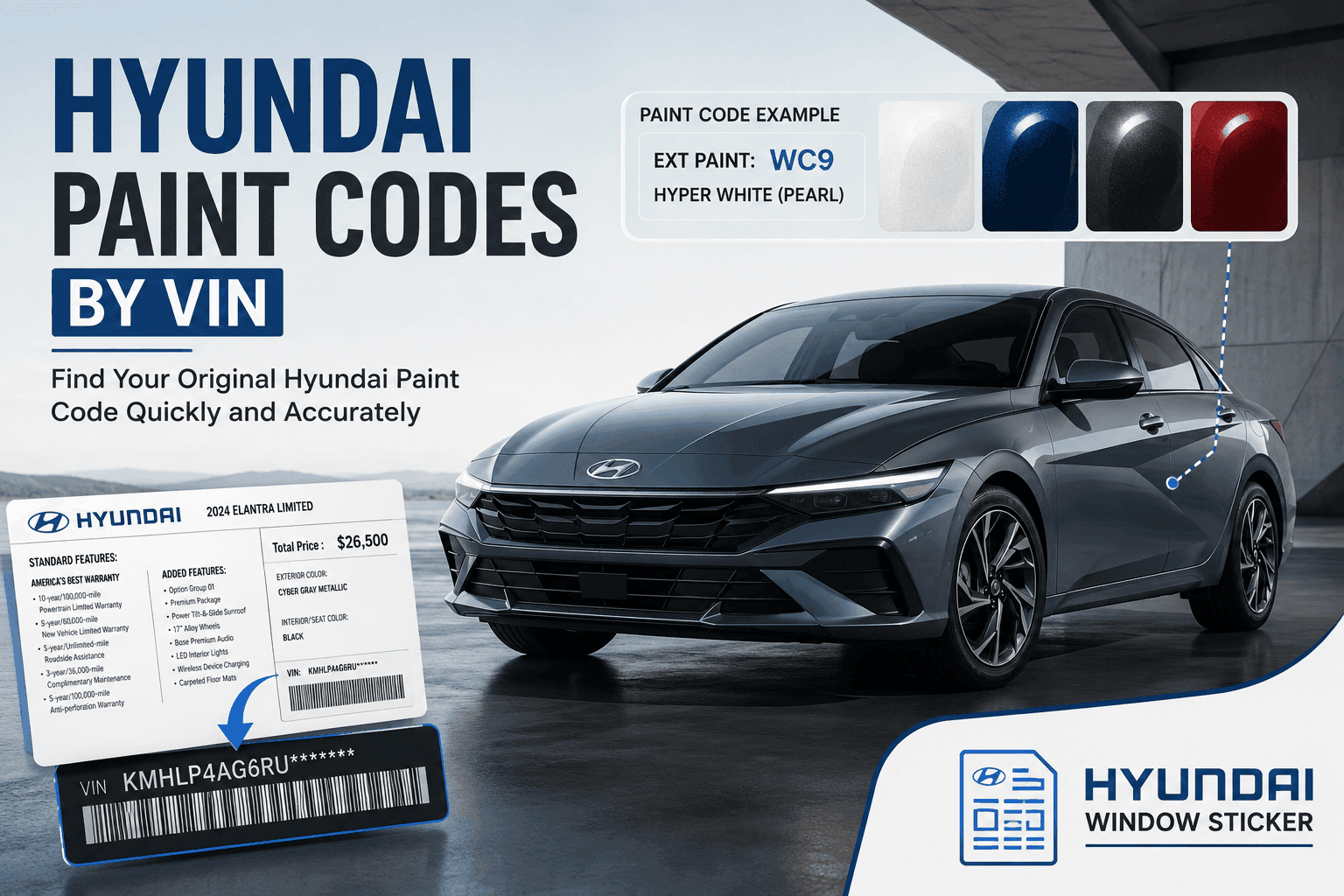
Key Takeways
 Hyundai paint codes are assigned color codes by the manufacturer to identify the exact colors on Hyundai models.
- Knowing the paint codes is important if you want to repaint the vehicle to ensure the color match
- A paint code can be found inside a label placed on the car, such as on the driver’s side opening door or the driver’s side B-pillar.
- If the label fades or is gone, use the Hyundai paint by VIN tool to check the interior and exterior colors.
Hyundai paint codes identify the exact factory color applied to a vehicle. You may need the code when repairing scratches, repainting a body panel, ordering touch-up paint, or restoring the original appearance after collision work. Color names alone are not reliable because Hyundai may use similar names for different formulas.
The two common ways to find the correct code are to check the factory paint label and to retrieve vehicle information by VIN. A Hyundai Window Sticker Lookup can help when the original label is missing, faded, painted over, or difficult to read.
What is a Hyundai Paint Code?
A Hyundai paint codes is a short group of letters and numbers assigned to a factory exterior finish. It tells a paint supplier or body shop which formula is used as the starting point for matching the vehicle.
The code is more useful than the marketing color name. A name such as Phantom Black, Polar White, or Typhoon Silver may be used across several model years, markets, or paint systems. The formula connected to that name may still change.
Paint codes often contain two or three characters, although formats vary by model and market. Copy the complete code exactly as printed. Do not confuse it with the VIN, trim code, transmission code, or tire information on the same label.
Why Paint Codes Matter
Using the correct paint code reduces the risk of a visible mismatch between the repaired area and surrounding panels. This is important on metallic, pearl, and tri-coat finishes because application technique can affect the final shade.
Accurate color identification supports:
- Better-looking scratch and chip repairs
- Consistent collision and insurance repairs
- Correct paint ordering by body shops
- Preservation of the factory appearance
- Fewer delays caused by ordering the wrong color
Even with the right code, age, sun exposure, previous refinishing, and spray technique can affect the match. A professional shop may tint or blend the paint into nearby panels.
Hyundai Paint Code Location
The most common Hyundai paint code location is inside the driver’s door opening. Open the door and inspect the door jamb, door pillar, and certification label near the B-pillar.
The code may appear in a small field among the VIN, tire specifications, and weight ratings. Depending on the vehicle, the field may be labeled PAINT, COLOR, or EXT COLOR.
If the sticker was removed, damaged during bodywork, or covered with paint, use the VIN to request the factory color from a Hyundai dealer or vehicle-information service. Hyundai support in some markets also asks owners to provide the VIN when requesting paint information.
Common Hyundai Paint Code Locations
Check these areas:
- Driver’s door jamb
- Driver-side door pillar or B-pillar
- Door edge on some older vehicles
- VIN certification or manufacturing label
- Firewall or radiator support on certain older models
- Owner’s manual for location guidance
Use a flashlight and clean the label gently. Strong solvents may erase the printed text.
What Does the Paint Code Label Look Like?
The label is commonly a white or light-colored manufacturer sticker. It may include a barcode, the VIN, build information, tire pressures, weight ratings, and other certification details.
Find a box or line marked PAINT, COLOR, or EXT COLOR. The value may look like W8, S3B, NKA, PAE, or another short code. Take a clear photo so you can compare it while ordering paint.
Hyundai Paint Code Locations by Model
Most Hyundai cars and SUVs use a similar label arrangement, but exact placement may change between generations. The following guidance covers the locations owners commonly encounter.
Hyundai Elantra Paint Code
On most Hyundai Elantra models, check the driver’s door jamb or driver-side B-pillar. The code is usually printed on the certification label near the VIN and weight information. On a used Elantra, check whether previous body repairs may have damaged or replaced the label.
Hyundai Sonata Paint Code
The Hyundai Sonata paint code is commonly found inside the driver’s door opening, either on the door jamb or pillar label. Some older references also identify the front radiator support as a possible location.
Hyundai Tucson Paint Codes
Hyundai Tucson paint codes are generally printed on the driver-side door jamb or B-pillar certification label. Look for a short code beside PAINT or COLOR rather than relying on a sales listing. Tucson colors can differ by production year, trim, and market. Verify both the VIN and production year before ordering paint.
Hyundai Santa Fe Paint Code
The Santa Fe paint code is commonly located in the driver’s door jamb or on the driver-side pillar. On some model years, the label may sit lower or farther back in the opening.
How to Find Hyundai Paint Codes by VIN
Finding Hyundai paint codes by VIN is useful when the physical label cannot be trusted. This can happen after accident repairs, repainting, door replacement, water damage, label fading, or importation from another market.
Step 1: Find the VIN
Check the driver’s side doorjamb, engine bay, windshield, or vehicle’s paperwork such as registration or title.
Step 2: Visit Hyundai Paint Codes by VIN
Visit the Hyundai paint by VIN page, then click on the form and enter the Hyundai VIN you want to check.
Step 3: Get the Window Sticker
See the preview page where you can check the vehicle’s specs and market value for free. Then, proceed to payment to get the complete window sticker to see Hyundai paint colors on the interior and exterior.
Popular Hyundai Paint Codes
Hyundai has used hundreds of exterior colors worldwide. Codes and names may vary by year, model, market, and paint supplier, so use this table as a general reference and verify the vehicle before ordering.
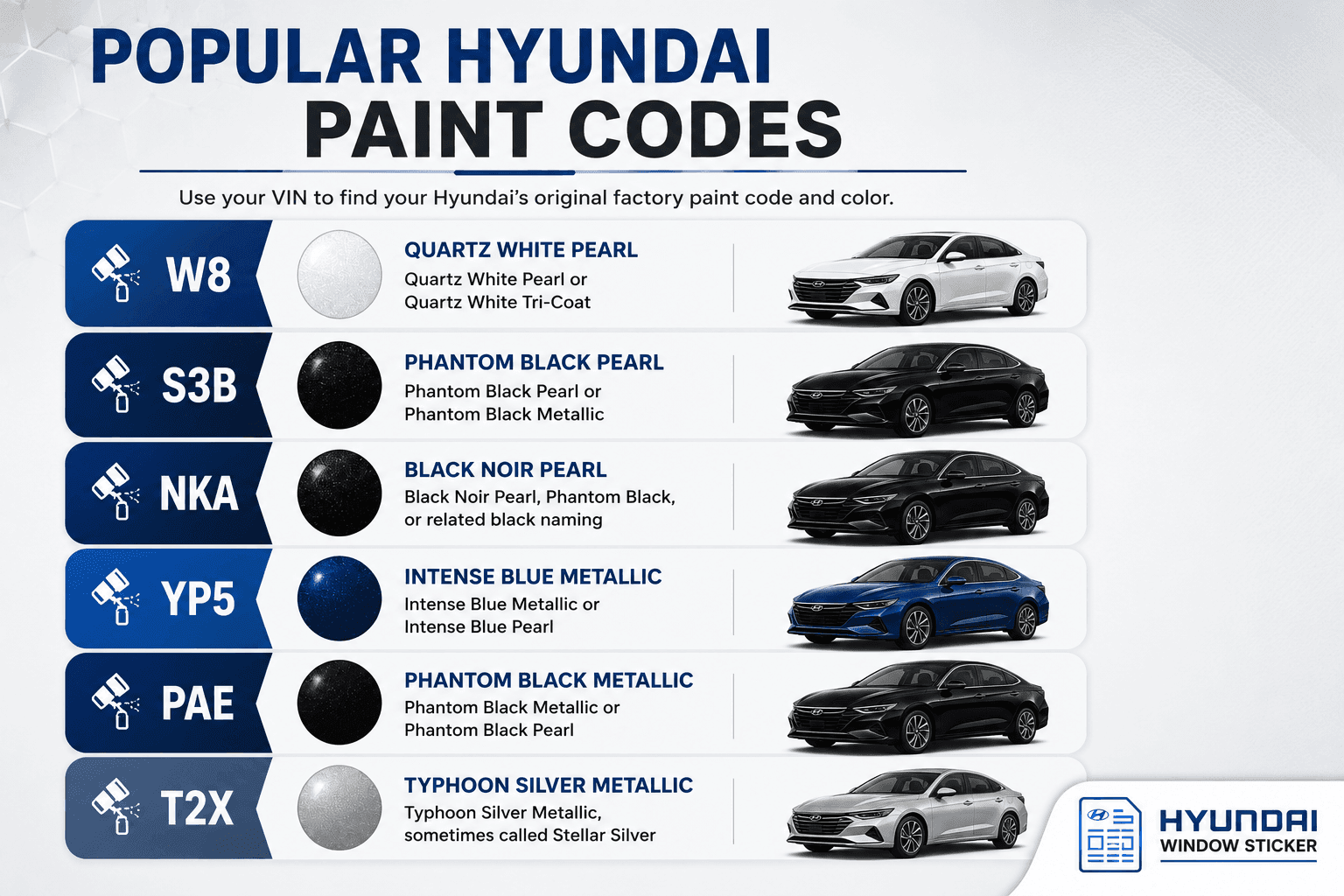
Published paint references associate W8 with Quartz White, S3B with Phantom Black, NKA with black pearl finishes, YP5 with Intense Blue, PAE with Phantom Black, and T2X with Typhoon Silver. Regional naming may still differ.
Hyundai Paint Code W8
The Hyundai paint code W8 is one of the most searched white finishes. It is commonly associated with Quartz White Pearl or a Quartz White tri-coat application, depending on the vehicle and repair system.
Because pearl formulas can involve more than one color layer, verify the Hyundai W8 paint code before ordering. A search for W8 paint code Hyundai products may return W8 and WW8 options, which should not be treated as interchangeable without checking the model and year.
Hyundai Paint Code S3B
The Hyundai paint code S3B is commonly associated with Phantom Black Pearl or Phantom Black Metallic. Pearl or metallic particles can make panel matching sensitive to spray angle, coverage, and clearcoat application.
Is Hyundai paint code S3B a 3-stage paint? Most S3B repair products are described as basecoat and clearcoat systems rather than three-stage finishes. Procedures may differ by model year, market, and supplier, so confirm the required system before refinishing.
How to Use Hyundai Paint Codes When Buying Touch-Up Paint
Copy the complete code from the label or confirm it through the VIN. Give the supplier the model, model year, production market, and paint code. Do not order by a broad name such as white, black, silver, or gray. Ask whether the product requires primer, basecoat, mid-coat, or clearcoat.
A touch-up pen or brush bottle may be enough for a small chip. Larger scratches, metallic colors, pearl finishes, and panel repairs need more controlled preparation. Damage that exposes bare metal should be cleaned and protected promptly to reduce corrosion risk.
Tips for Getting the Best Color Match
Choosing the correct paint code is only part of the process. Follow these simple tips to improve color accuracy and achieve a better finish when repairing or touching up the paint.
Clean the Surface First
Wash the panel before checking the color. Dirt, wax, and oxidation can make the paint appear different from its actual shade.
Verify the Paint Code
Match the paint code with the vehicle year, VIN information, and the paint supplier's product details before ordering.
Check the Color in Daylight
Natural daylight provides the most accurate color comparison. Indoor lighting can make pearl and metallic paints look different.
Test Before Painting
Apply a small test sample on a hidden area or test card to confirm the color before painting the repair area.
Blend Larger Repairs
Blending the new paint into nearby panels helps reduce visible color differences on larger repair areas.
Look for Previous Repairs
Repainted panels may not match the original factory color, even if the paint code is correct.
Common Mistakes When Looking for Hyundai Paint Codes
A frequent mistake is entering the VIN into a paint website that does not decode factory build information. The VIN must be connected to a reliable vehicle record, dealer catalog, or specification source before it can identify the original color.
Other mistakes include:
- Confusing the trim code with the exterior paint code
- Reading a character incorrectly on a faded label
- Ordering by the advertised color name alone
- Ignoring the production year or sales market
- Assuming similar codes use the same formula
- Buying the wrong paint system for a pearl finish
- Matching a repainted panel only to the VIN color
When the label is unclear, take several photos and compare the result with VIN-based data. For major bodywork, ask the supplier or repair shop to verify the formula before mixing.
Final Thoughts
Hyundai paint codes provide the best starting point for matching the original factory finish. Check the driver’s door jamb or certification label first, then confirm the code against the model year and VIN before buying paint.
If the label is missing, damaged, or unreadable, you may look up the window sticker or Hyundai build sheet to help recover the original exterior color and other factory specifications. Verification is especially important for pearl, metallic, and tri-coat finishes.